Western General Hospital
1868-1885 St Cuthbert's and Canongate Poor House.
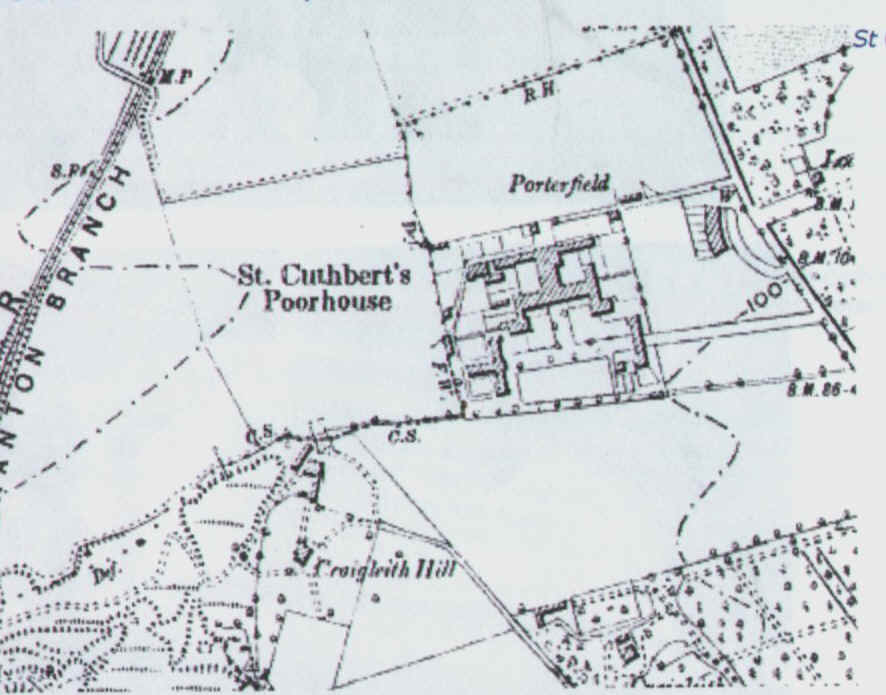
St Cuthbert's Poorhouse (with its typical clock tower) was opened on the 21st
December 1868. This map shows the location of the Poorhouse as it was in a diagram
dated 1868.
This shows the extensive buildings (Craigleith Sandstone is reported to
have been used in the construction) that were described as St Cuthberts
Poorhouse surrounded in those days with wide open spaces.
The ground was acquired from the Fettes Trustees and consisted of ten
acres of farmland at Porterfield, Craigleith. The roadway up to the present
Outpatients is still called Porterfied Road.
Notice the curved row of houses, Moredun Crescent, between the
Poorhouse and the West side entrance to Fettes. The row of houses was believed
to have been built to stop the "Fettes Boys" from "seeing into" the Poorhouse.
The name Moredun is a bit confusing as Moredun district is better known on
the South side of Edinburgh. On the 1st February 1968, it was renamed Carrington Crescent
after Lord Carrington, Governor of New Zealand 1885-1890 who was connected to Fettes College.
Development Timeline - Western General Hospital, Edinburgh
- 1885-1895 - St Cuthbert's Poorhouse
- 1895-1914 - Craigleith Poor House.
- 1914-1918 - 2nd Scottish General Hospital Craigleith.
- Described as Craigleith Poor Law Hospital Intermittently in various reports.
- Described as Craigleith Hospital Intermittently in various reports.
- 1902 - Governors House.
- 1912 - Childrens Hospital and smaller building next to it built. Both red brick similar to Nurses Home.
- 1935 - Gatehouse modified to allow ambulances to enter.
- 1936/37 - Nurses Home built.
- 1937 - Recreation Hall started to be built. Demolished in 1994.
- 1938 - Reconstruction of Hospital deferred.
- 1938 - New boiler house was built.
- 1939/45 - Childrens Hospital became the Paderewski Hospital for Polish combatants and civilians. Paderewski was a Polish National hero and world famous pianist.
- 1939 - Pathology Block built.
- 1950 - Paderewski Hospital becomes the casualty and OP department. Building surrounded by trees bottom right in photo A below.
- 1952/56 - Radiotherapy Unit and related wards built.
- 1952/60 - Surgical Neurology Unit built. Large four storey building in front of the Crescent in photo A below.
- 1959 - Central Microbiological Unit built. Long building at the back entrance onto Telford Road. See photo A below.
- 1964 - Kidney Transplant Unit built. Bottom centre of photo above showing bridge from Transplant Unit into Radiotherapy Unit.
- 1966 - Boiler House (No.3) and Laundry with concrete chimney built demolished and rebuilt. Just out of shot at top of photo A below. Can just make out laundry wall and to its right and down is what remains of Boiler house No.2.
- 1966/68 - Outpatient Casualty and Diagnostic block built Large rectangular building just off centre in photo above.
- 1968 - Human Genetic Building (1st building) built. Whitish four storey building second in from right centre of photo above.
- 1969 - Scottish Health Centre for research into Hospital design built.
- 1969 - Haematology/Biochemistry Laboratories built on ground in front of clock tower.
- 1970/72 - Human Genetics Block 2nd building built. Carrington Crescent buildings demolished to make way for it.
- 1974 - Extension to Scottish Health Centre built.
- 1975 - Cyclotron Unit built.
- 1980 - Medical Oncology Unit (prefab) erected.
- 1988 - Alexander Donald Building built. Large H building to left centre of photo B below.
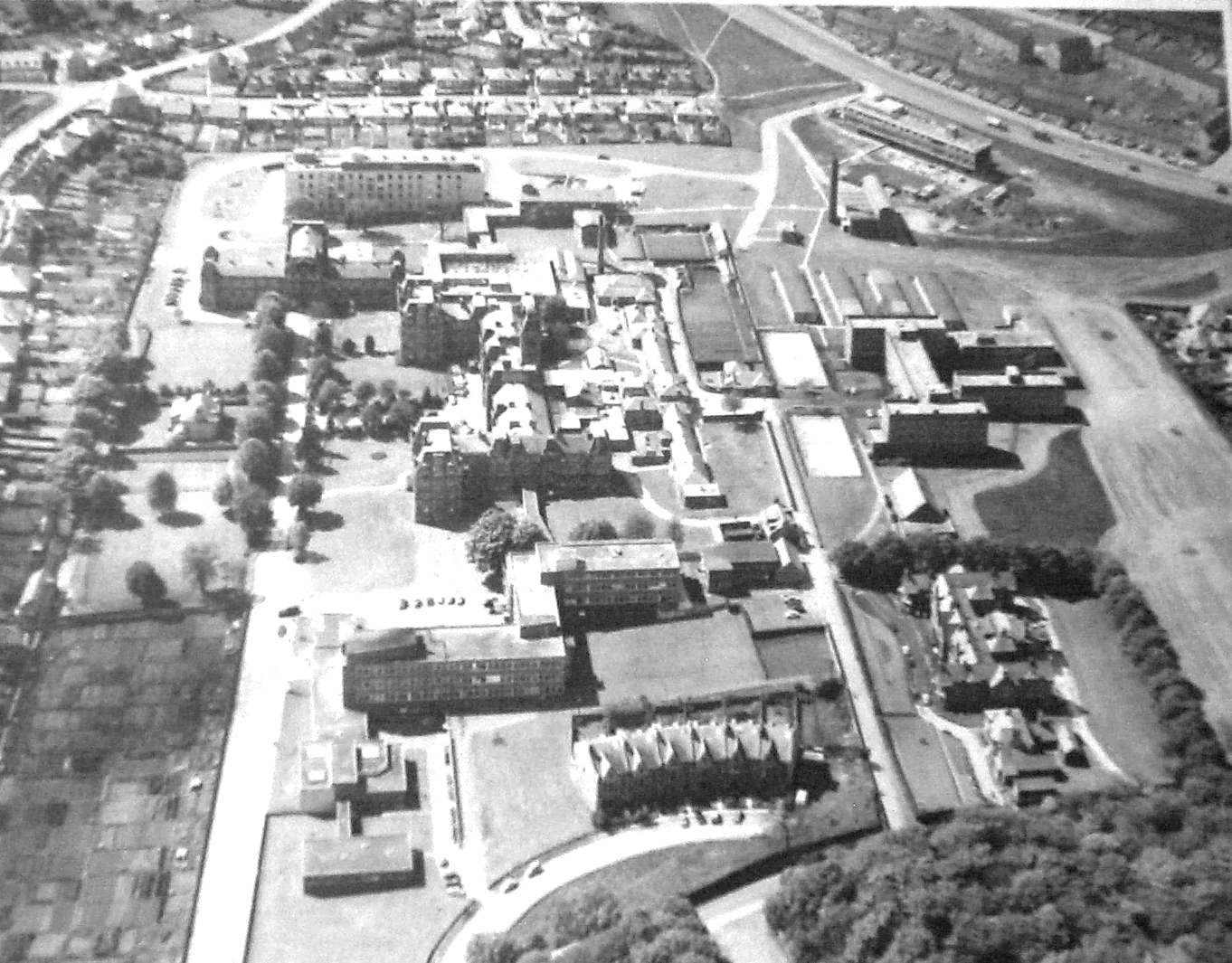
Photo A - This photo above is of the WGH site in the 1960s
Can you find the original boiler house and chimney and then the second boiler house
and chimney?
The third boiler house and concrete chimney is to be built in the space
top right of photo above just below Telford Road.
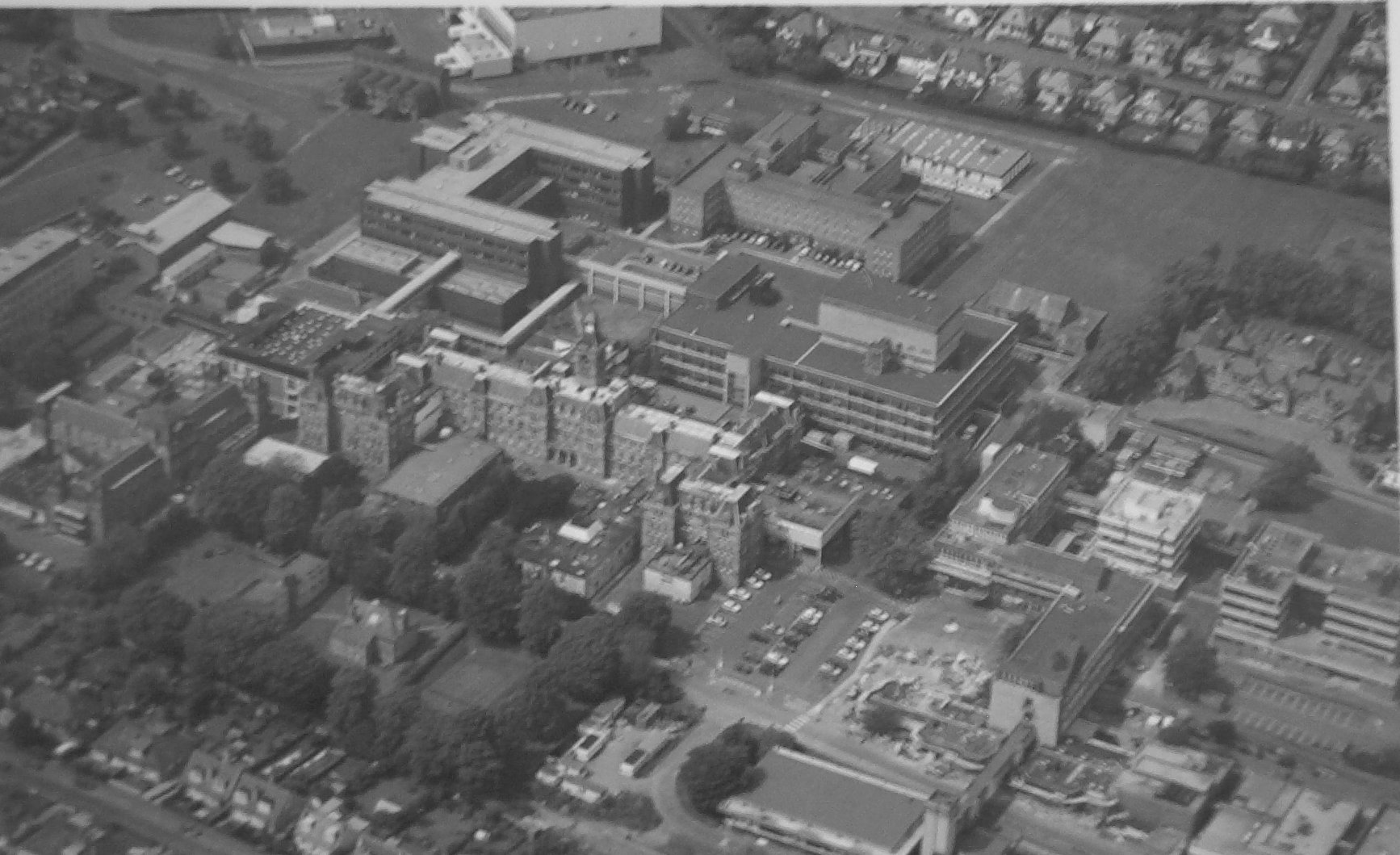
Photo B - What the WGH site looked like in the 1980s.
Built in the last few years:
- Infectious Diseases Unit Built to the left of the Alexander Donald Building. Top left of photo above.
- Molecular Medicine: Built into space middle right side of photo just in front of Paderewski building.
- Anne Ferguson Building: The main access point to many of the WGH Out Patient Dept clinics as well as other wards.
- This was built on the site of Nurses home and small recreational hall.
- ICRF Building: Built into space bottom right where the car park spaces are marked out!!!!
2003 on
The Hospital has doubled if not trebled the space it originally was built on. It has
reportedly something like 3,500 staff working on site which includes Hospital as well
as Research Laboratories. Car parking is at a premium
in the grounds and is difficult to find a space. The surrounding districts
residential areas were once used for car parking but
unfortunately this was done indiscriminately and lead to the introduction
of single yellow lines and then a Controlled Parking Zone.
The present fee for parking in this controlled area is £1 per hour for a
maxium of four hours only.
Detailed information is available on the
present day facilities at the
Western General Hospital at the following web site:
http://www.lhsa.lib.ed.ac.uk
A book entitled A History of the Western General Hospital by Martin
Eastwood and Anne Jenkinson 1995 gives a detailed description of the Western
General Hospitals' involvement in medicine since 1868. Anne Jenkinson is a long time
resident of Craigleith and the above book can be borrowed from public libraries
2010
<
The WGH still has problems with car parking.
Building of a two tier car park is now complete but the increase in car
spaces only compensated for the loss of car parking now that the
replacement for the Royal Victoria Hospital has started to be built on
the site of the Paderowski Hospital and its car park.